The very first Christian Bible had no Old Testament in it at all. It was put together about a hundred years after Jesus died, by a man who loved Jesus so much that he could not make the God of Jesus fit with the God of the old books. He looked for the Father that Jesus talked about in those old stories of wars and floods and punishments, and he could not find him there. So he set the old books down and kept only the writings about Jesus. His name was Marcion, and the question he asked sits underneath every lesson about the Father Jesus showed us.
A shipowner comes to Rome
Marcion came from Sinope, a busy harbor town on the south shore of the Black Sea, in the land we now call Turkey. He owned ships, and he had grown rich carrying goods across the water. Around the year 140, he sailed to Rome, the capital of the empire, and joined the Christians who met there.
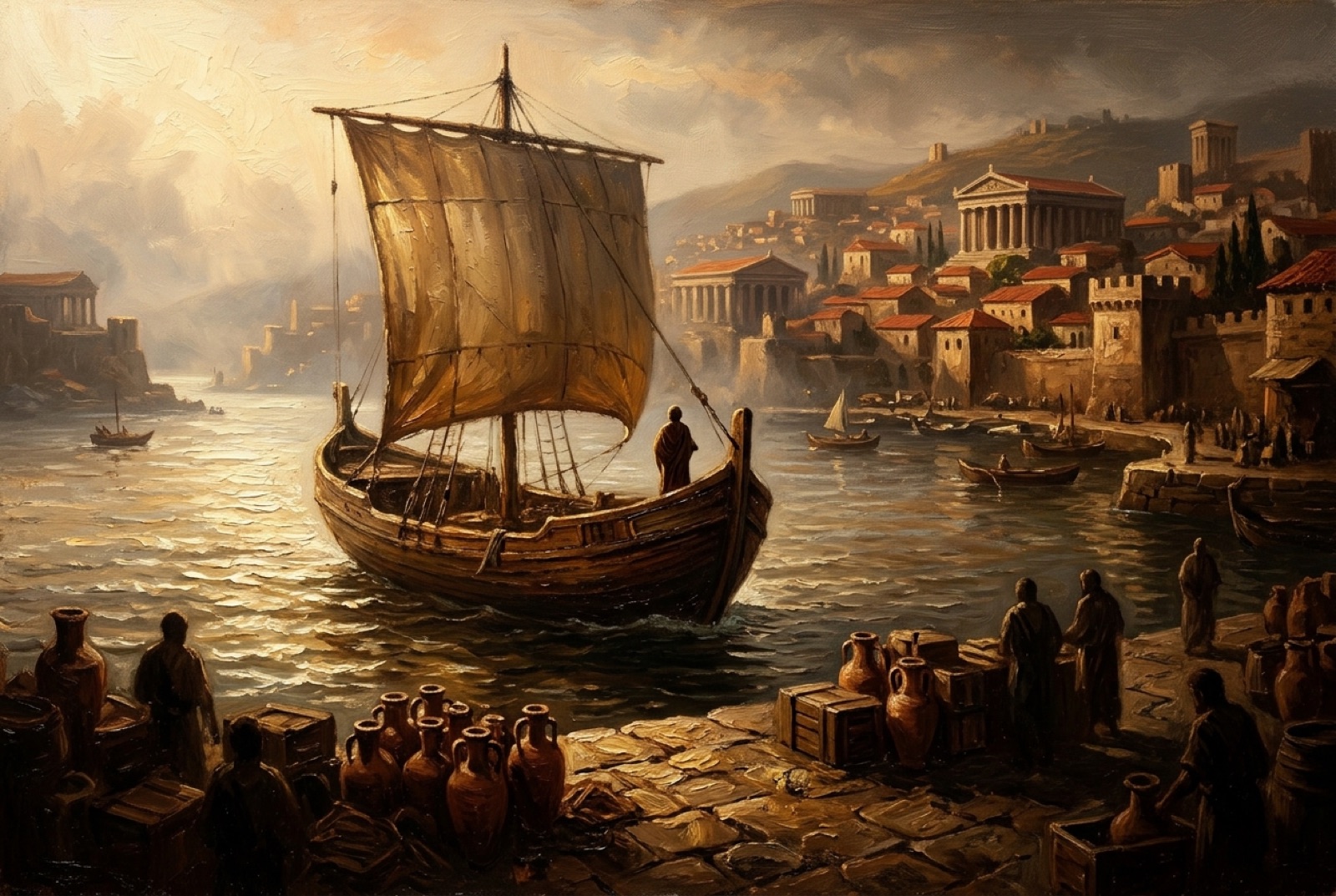
He did not come empty-handed. He gave the church in Rome a very large gift of money, two hundred thousand coins called sesterces, enough to feed and house many families for years. The Christians in Rome were still a small group who met in homes, and they had no power and no protection from the empire. A gift like that would have been talked about in every house where they gathered.
Then Marcion began to teach, and what he taught troubled the leaders of the church. He said that the God of the old books, the God who sent the flood, who ordered wars, and who wrote laws with death as the punishment, was not the same as the Father Jesus came to show. That old God, he said, was a real maker of this world, but he was a lesser god: strict, quick to punish, and focused on keeping score. The Father of Jesus was someone else entirely, a good God and a stranger to this world, whom no one had known until Jesus came and showed him.
Marcion even wrote a book to prove it. He called it Ἀντιθέσεις (Antitheseis), which means "opposites." In it he set what the old books say beside what Jesus said, one next to the other, so that anyone could see how far apart they were.
The first Christian Bible
Around the year 144, Marcion did something no one had done before. He made a list of the writings that Christians should treat as their holy books.
At that time there was no New Testament. There were gospels, the accounts of Jesus's life, and there were letters written by Paul, the traveling teacher who had carried the message of Jesus to cities all around the sea in the years after Jesus died. Churches read from these, along with the old books, but no one had drawn a line around a set of writings and said, "These are ours."
Marcion drew that line. His Bible had two parts. The first was one gospel, which he simply called "the Gospel." It was very close to the book we know today as the Gospel of Luke, only shorter. The second part was ten of Paul's letters. There was no Genesis, no Moses, and no book of Kings, because for Marcion the good news of Jesus did not need the old books to hold it up.
He also believed that the accounts of Jesus were already being changed in his own day. He said that some teachers were adding lines to make Jesus look like he was continuing the old religion, when, as Marcion saw it, Jesus had come to show a Father no one had known. So he tried to remove what he believed had been added, and to keep only what he believed was true about Jesus.
Sent away, and the money sent back
The leaders of the church in Rome met with Marcion in the year 144. They would not accept his teaching, and they sent him out of the church. Then they did something that people remembered for a long time afterward: they gave him back every coin of his gift.
Marcion did not stop. He went out and started churches of his own, and they grew fast. Within a few years, a Christian teacher in Rome named Justin wrote that Marcion's teaching had reached people in every land. Marcion's churches had their own leaders and their own meeting houses. More than a hundred and seventy years after he was sent away, people near Damascus, the old city in Syria, carved a stone over the door of their meeting place, and on it they called themselves Marcionites. Three hundred years after him, a bishop in Syria wrote that there were still whole villages of them in his area.
His list of holy books changed the church that sent him away. Once Marcion had drawn a line around a set of writings, the other churches began to draw lines of their own, and his list was one of the reasons they did. Over the next two hundred years, they slowly settled on the books they would keep. In the year 367, Athanasius, a bishop of Alexandria in Egypt, sent a letter to his churches naming the twenty-seven books we now call the New Testament. His list kept the old books, too, alongside the new ones, and so the church answered Marcion by tying Jesus and the old God together.
The others who saw the same difference
Marcion was not the only early Christian who saw that the God of the old books and the Father of Jesus looked very different. Other teachers, known today as the gnostics, from the Greek word γνῶσις (gnōsis), which means "knowing," saw it as well.
For a long time, almost all we knew about them came from the people who wrote against them. Then, in December of 1945, two brothers were digging for soft soil to put on their fields near the town of Nag Hammadi, beside the Nile River in Egypt. They hit a large clay jar buried in the ground. Inside were thirteen old books bound in leather, which had been hidden there more than fifteen hundred years earlier. They held dozens of early Christian writings that had been lost for centuries.
One of them is called the Secret Book of John. It tells of a great Father beyond this world. This Father is pure spirit, full of light and goodness, and no eye has ever seen him. Far below him, the book says, a lesser being came into existence, and this lesser being made the physical world we live in. He did not know about the true Father above him, so he boasted that he was the only God. In this story, Jesus comes down from the true Father to wake people up and to show them the way home to the Father, a way that leads through Jesus himself.
The gnostic teachers and Marcion did not agree on everything, but they shared one thing. They both loved Jesus, and they both saw a difference so wide between his Father and the God of the old stories that they could only explain it by saying the maker of the old stories and the Father of Jesus were not the same.
Who got to name God
Their answer lost, and the world they lived in helps explain why. It was a world full of gods. Every city had its own temple and its own god, the way it had its own walls and its own market. Rome had Jupiter. Ephesus, a large city on the coast of what is now Turkey, had a famous temple to Artemis. The people believed these gods were real, and they believed each god fought for its own people.
That did not end when Jesus came. Six hundred years after him, in Arabia, the shrine at Mecca still held the images of many gods that different tribes came to worship, and the whole region still worshiped many gods long after Jesus walked through Galilee.
In a world like that, the side that wins gets to write down which god is the true one. As the church grew stronger, its leaders named their God the God of Abraham, the ancestor of the descendants of Jacob in the old books, and they tied Jesus to that God. They said Jesus was the purest word of that same old God. Marcion and the gnostic teachers lost that argument, and so their books were thrown out, hidden, or burned. Later faiths also claimed Jesus as one of their own, and they brought back the old rituals of the God of Abraham, like the sacrifices, the holy days, and the rules about food and washing that Jesus had set aside.
Two possibilities
Marcion and the gnostic teachers gave one answer. Another answer is also possible: the old God may never have existed at all. People may have made up the stories about him, the same way every people around them made up stories about their own gods.
The second answer has clay tablets behind it. In the 1800s, a man named George Smith was working at the British Museum in London, reading old clay tablets that had been dug up in Iraq. In 1872 he found one that told of a great flood. In that story, a god warns a man named Utnapishtim that a flood is coming. Utnapishtim builds a huge boat and fills it with his family and animals. When the rain stops, the boat comes to rest on a mountain, and he sends out birds, a dove, a swallow and a raven, to see if the land is dry. This story comes from the Epic of Gilgamesh, a long poem about a king named Gilgamesh, and it is older than the book of Genesis. Even older tablets from the same land tell the same flood with other heroes, named Atrahasis and Ziusudra.
So the same story was told in more than one land, and each one put different names in it. That would make sense if people were passing ancient stories from one to another and giving them to their own god each time.
Jesus once named Noah, the man in the flood story of the old books. In the Gospel of Matthew, chapter 24, he said that in the days before the flood people were eating and drinking and marrying, and they were not ready when the water came. Jesus used a story everyone in the room grew up with to make a new point, about being ready. He never said the Father sent that flood.
We do not know which of the two answers is true. The old God may be a lesser god who belongs to this physical world, or he may be a god the stories invented. What we do know, and can say plainly, is that the God Jesus showed us is starkly different from both.
What Jesus said about the Father
In the old books, most of the people who heard from God heard from angels, messengers who brought word from him. Abraham welcomed three visitors to his tent. Jacob wrestled with a stranger through the night. The old books also say that the people heard a voice at the mountain called Sinai, and that Moses spoke with God face to face.
Jesus said something very different. The Gospel of John, in chapter 6, tells how Jesus fed a huge crowd beside the Sea of Galilee, the large lake in the north. The next day the crowd followed him to Capernaum, a fishing town on the shore, and in the meeting house there he told them he was the bread that came down from heaven. They grumbled, because they knew his father and mother, so how could he have come down from heaven? Jesus answered them, people who had heard about Moses all their lives, and told them no one had seen the Father except him.
Not that any man hath seen the Father, save he which is of God, he hath seen the Father. (John 6:46)
Later, in chapter 14 of the same gospel, Jesus was eating his last supper with his closest friends on the night before he died. He told them he was going to his Father's house, and that they knew the way. One of them, Thomas, said they did not even know where he was going, so how could they know the way? Jesus told him:
Jesus saith unto him, I am the way, the truth, and the life: no man cometh unto the Father, but by me. (John 14:6)
And he lived out how different his Father was. He broke the Sabbath commandment, the law of rest, in public and on purpose, so that people could be healed. He set aside many of the laws of Moses, like eye for eye, the swearing of oaths, the easy sending away of wives, and the rules about what made a person unclean. Yet when a man ran up and knelt in the road before him, in the Gospel of Mark, chapter 10, Jesus told him to keep the commandments against killing, adultery, stealing and lying, and to honor his father and mother. Jesus kept what came from love and set aside what came from fear.
Coming back to Marcion
So when Marcion looked for the Father of Jesus in the stories of floods and wars and could not find him, he was seeing something true. A God who drowns the world does not sound like the Father no one had seen. A God who orders a town wiped out does not sound like the one Jesus described, who sends rain on the good and the bad alike. Marcion gave his money, lost his place in the church, and had his gift handed back to him, all because he would not pretend that those two pictures of God were the same.
You may have felt that same thing. Maybe you read the old stories as a child and something in you quietly said that this did not sound like Jesus. You were seeing the same difference Marcion saw, and the same difference Jesus came to show.
Each lesson after this one looks at the Father Jesus revealed, who belongs to no single tribe, who wants no blood, and who loves every one of his children. Jesus is the way to him, and the door is open.