A young man walks down a dusty road toward the farm where he grew up. His clothes are torn and he smells like the pigs he has been feeding. He has spent every coin his father gave him, and he has a little speech ready, because he is sure his father will be angry. But long before he reaches the gate, an old man looks up from the farm, sees him far off, and starts to run.
Jesus told that story, and the whole lesson is inside it. God loves every one of his children, and he sent Jesus so that every one of us could come home to him. He wants all of us. And Jesus, who knew the Father better than anyone, said plainly that not all of us will make it. Both of those things are true at the same time, and when you hold them together, you find a Father who never stops running toward you.
What Jesus said about the narrow gate
The words come from the Sermon on the Mount, the long talk Jesus gave to a crowd on a hillside in Galilee, the hill country north of Jerusalem. It fills chapters 5, 6 and 7 of the Gospel of Matthew. Near the end, Jesus had just given the crowd the rule that sums up everything he taught: treat other people the way you want them to treat you. Then he told them how hard it is to actually live that way, and how few people do.
Enter ye in at the strait gate: for wide is the gate, and broad is the way, that leadeth to destruction, and many there be which go in thereat: Because strait is the gate, and narrow is the way, which leadeth unto life, and few there be that find it. (Matthew 7:13-14)
"Strait" is an old English word for tight. The word Jesus used for where the wide road ends is ἀπώλεια (apōleia), which means "destruction" or "being lost." The word he used for where the narrow road ends is ζωή (zōē), which simply means "life."
He was talking to farmers, fishermen and families who had come out to hear him, and he was being honest with them. Most people go the easy way. They pay back the person who hurt them, they look after their own and ignore the stranger, and they keep the rules that make them look good. The way of life is the way Jesus himself walked: forgiving, giving, loving the enemy, caring for the person no one else would touch. That way is narrow because it is hard, and it is hard because it asks for everything.
The way is living as he lived
On the last night before he died, Jesus ate supper with his closest friends in a room in Jerusalem. The Gospel of John tells about that night in chapters 13 to 17. Jesus had just washed their dusty feet, the job of the lowest servant in a house, and now he told them he was going away. One of them, a man named Thomas, said what they were all feeling. He said they did not even know where Jesus was going, so how could they know the way? Jesus answered him:
Jesus saith unto him, I am the way, the truth, and the life: no man cometh unto the Father, but by me. (John 14:6)
He had just knelt on the floor with a towel and a bowl of water, so Thomas did not hear a password or a list of rules. The way to the Father was the life Jesus had lived in front of them for all those days on the road. Earlier that same evening he told them why he washed their feet: so that they would do for each other what he had done for them.
So the way to God is living as Jesus did. Every step along that way brings you closer to the Father, and the further you go, the more the Father can reach you. When you forgive someone who does not deserve it, something opens between you and God. When you feed someone who cannot pay you back, it opens a little more. Later that night Judas, one of the twelve (not the one who betrayed him), asked Jesus why he would show himself to them and not to the whole world, and Jesus answered:
Jesus answered and said unto him, If a man love me, he will keep my words: and my Father will love him, and we will come unto him, and make our abode with him. (John 14:23)
The Father comes and lives with the person who lives the way Jesus lived.
Why he sent Jesus at all
Jesus also said that no one had ever seen the Father, except the one who came from God. People in every land had told stories about God for thousands of years. Most of those stories were about angels who carried a message from heaven, or about a god who fought on one people's side and won its battles. Jesus came to show us who the Father really is, because no one had shown us before.
A Father who wanted only a few of his children would never have sent anyone. He sent Jesus because he wants every one of us. In the Gospel of Matthew, chapter 18, Jesus stood a small child in front of his friends, and then he told them about a shepherd who leaves ninety-nine sheep on the hills to look for the one that wandered away. When the shepherd finds it, he is happier over that one sheep than over the ninety-nine. Then Jesus said:
Even so it is not the will of your Father which is in heaven, that one of these little ones should perish. (Matthew 18:14)
The Father's wish is that every child comes home, every single one. And still, Jesus told the crowd on the hill that few would find the narrow way. The Father knows that some of his children will not be able to reach him, and he loves them anyway.
What the Father does not do
Many people were taught that God sends sickness and disaster to punish people. Some were told that a child's cancer was part of God's plan, or that a flood was God's anger. Jesus never taught that. In the same Sermon on the Mount, when he told the crowd to love their enemies, he gave them the reason:
That ye may be the children of your Father which is in heaven: for he maketh his sun to rise on the evil and on the good, and sendeth rain on the just and on the unjust. (Matthew 5:45)
He spent his days healing sick people, and he never once told a sick person that God had made them sick. God did not create cancer, and he does not hand out pain.
There is an old story from the books of Moses, the leader who, the story says, brought the descendants of Jacob out of slavery in Egypt. It tells that God went through Egypt at night and killed the oldest son in every Egyptian house, from the son of Pharaoh, the king, down to the son of the poorest prisoner, so that the king would let the slaves go. Whoever that story is about, it is not the Father Jesus showed us. Either it tells of a lesser god of this world, or someone made it up. What we know is that the Father of Jesus did not kill the firstborn of Egypt. The Father Jesus showed us is the one who does not want one of these little ones to be lost.
The children who cannot wake up to him
Some people live their whole lives without ever turning toward God. Some were hurt so badly by people who used God's name that they cannot hear his name anymore without pain. Some were taught to hate, and never got the chance to unlearn it. Some are so busy just staying alive that they never have a quiet hour to look up. Their spirit never wakes up to the Father, and they never find the narrow way.
The Father still loves them. He loves them the way a father loves a son who has gone to a far country and stopped writing home. He does not stop being their Father because they cannot reach him. It grieves him, because he wants them home, but his love does not shut off.
No place above, no pit below
So what happens after this life? Many of us were given a picture of two places: a city in the clouds for the good people, and a fire under the ground for the bad ones. Jesus did talk about the kingdom of heaven, and he talked about his Father's house. He said it on that same last night, to friends who were scared he was leaving them:
Let not your heart be troubled: ye believe in God, believe also in me. In my Father's house are many mansions: if it were not so, I would have told you. I go to prepare a place for you. (John 14:1-2)
The Greek word behind "mansions" is μοναί (monai), which means "places to stay" or "rooms to live in." A few lines later, Jesus used the same word, μονή (monē), when he said that he and the Father would come and make their "abode" with the person who loves him. The rooms in the Father's house are what it means to live with the Father, and to have the Father live with you. That is heaven: being united with him.
And the other side has no pit under the ground. It is being apart from the Father. Jesus gave that a name everyone in Jerusalem knew. He called it Gehenna, in Greek γέεννα (geenna), which was the valley of Hinnom, a real valley just outside the walls of Jerusalem. Long before Jesus was born, people there had burned their own children as gifts to Molech, a god they believed wanted blood. Later the valley became a place where the bodies of the unburied dead were left. Centuries after Jesus, English Bible translators replaced the name of that valley with an old Germanic word for the world of the dead, and so a valley anyone could walk to became a place under the earth.
But Jesus knew exactly what that valley was. When he named it, he was naming the place where people ended up when they followed a god who wanted the death of children. Being apart from the Father looks like that: so far from him that you can do the worst things and believe you are doing right. Gehenna is where people go when they walk away from him and follow a god who wants blood, and the Father never hands it out as a punishment.
So there is being united with the Father, and there is being apart from him. There is a Father who wants every child home, and children who are free to come or to stay away.
The father who ran
The young man on the road is in the Gospel of Luke, chapter 15. His story is the third of three that Jesus told that day. First a shepherd finds one lost sheep, then a woman finds one lost coin, and then a father gets back one lost son. Jesus told all three because some religious teachers, men called Pharisees and scribes, were complaining out loud that he welcomed sinners and ate with them. These three stories were his answer to them.
In the story, the younger son had asked for his share of the family money while his father was still alive, which was the same as saying he wished his father were dead. He took the money to a far country and wasted all of it. When a famine came, he ended up feeding pigs and was so hungry he wanted to eat their food. So he decided to go home and ask to be a hired worker. He did not even hope to be a son again. Then Jesus told what the father did:
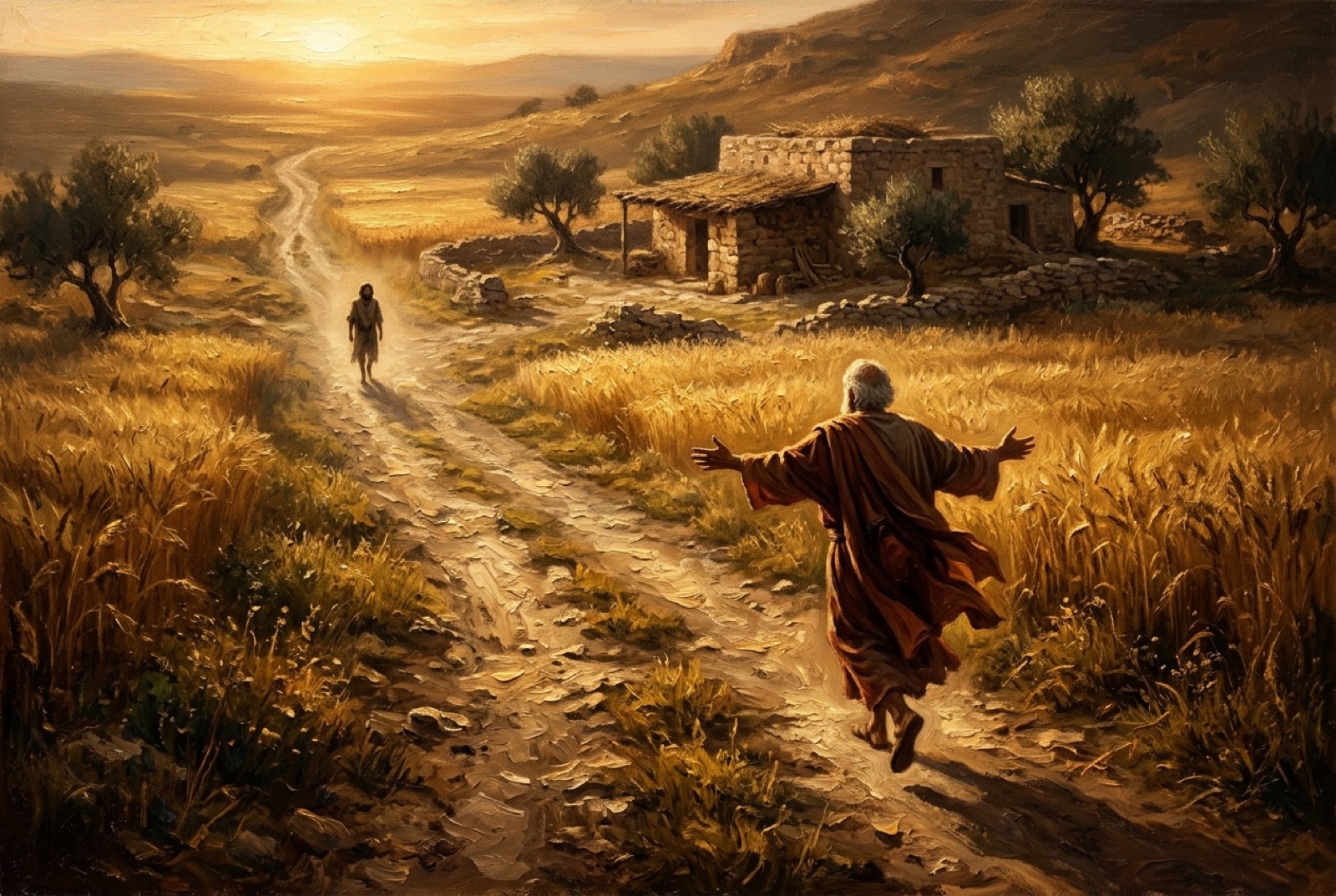
And he arose, and came to his father. But when he was yet a great way off, his father saw him, and had compassion, and ran, and fell on his neck, and kissed him. (Luke 15:20)
The son never finished his speech. The father called for the best robe, a ring for his hand and shoes for his feet, and he threw a feast, and he told everyone why:
For this my son was dead, and is alive again; he was lost, and is found. And they began to be merry. (Luke 15:24)
The son had left. He was far away, and for a long time he did not reach his father. But the father kept looking down that road, and the moment the son turned around, the father ran out to him. He did not wait at the door with his arms folded, and he did not ask for an apology first. He ran.
That is the Father Jesus showed us. Not all of his children will come back down the road, and Jesus was honest about it. But no child will ever turn around and find the Father gone. He is the one standing at the edge of the farm, watching the road, ready to run.
What this means for you
If you were raised to fear a God who keeps a list and burns the names that fail, you can set that fear down. Jesus never showed us that God. He showed us a Father who wants you home so much that he sent his own Son to show you the way, and who will run to meet you the moment you turn toward him.
The way is narrow, because loving the way Jesus loved is hard for everyone. But you do not walk it alone, and every step you take toward forgiveness and kindness is a step the Father sees. The further you go, the closer he comes, until he and Jesus make their home with you.
And if there is someone you love who has not turned toward God, someone who is still in the far country, the Father has not given up on them either. He is watching that road too.