In a small village, a woman named Mary sat down on the floor at the feet of Jesus and listened to him teach. In that world, the place at a teacher's feet belonged to a student, and students were men. Her sister was upset and wanted Jesus to send her back to the kitchen. Jesus said no. He let Mary stay, and he said that what she had chosen would not be taken away from her.
That one moment shows how Jesus saw women. The old law written in the books of Moses counted a wife among the things a man owned. A letter written later, under the name of Paul, told wives to obey their husbands in everything. But Jesus treated women as his students, his friends, his helpers and his first witnesses. And he taught that when we are united with the Father, no husband rules over a wife at all.
So where did the old picture come from, and how did Jesus set it aside?
What the old law said about women
The Ten Commandments are the ten rules the books of Moses say were given on a mountain called Sinai. The last of the ten tells a man not to want what belongs to his neighbor, and then it lists those things. It names his house, his wife, his male and female servants, his ox and his donkey. The wife sits in the middle of the list, between the house and the servants, counted as one of the things a man has.
The rest of the law follows the same pattern. If a young woman living in her father's house made a promise to God, her father could cancel it on the day he heard about it. If a married woman made a promise, her husband could cancel it the same way. Her promise to God held only if no man in charge of her said no. Only a widow, or a woman whose husband had sent her away, could make a promise that no one could undo.
There is a harder law still. If a man took a young woman who was not engaged, the law did not ask what she wanted. He paid her father fifty pieces of silver, he had to marry her, and he could never send her away. The money went to her father, because the law saw the loss as his. She was made to spend her whole life with that man.
Every people in that part of the world wrote laws like these. The old law codes of Babylon, the great kingdom far to the east on the Euphrates River, also put daughters under their fathers and wives under their husbands. That was the common way of the ancient world, and the books of Moses wrote it down as the word of God.
What a later letter said
After Jesus died and rose, his followers wrote letters to the small groups of believers in different cities. Paul was one of those writers. He had once hunted the followers of Jesus, and then he became one of them and traveled far to tell people about him. Many letters in the New Testament carry his name.
One of them is called Ephesians, a letter to the believers in Ephesus, a large city on the coast of what is now Turkey. In chapter 5 it speaks to husbands and wives. The letter wanted every home to run in a set order, and so it said this to the wives:
Wives, submit yourselves unto your own husbands, as unto the Lord. For the husband is the head of the wife, even as Christ is the head of the church: and he is the saviour of the body. Therefore as the church is subject unto Christ, so let the wives be to their own husbands in every thing. (Ephesians 5:22-24)
Many scholars believe Paul did not write Ephesians. Its words, its style and its ideas are different from the letters that Paul surely wrote, and so these scholars believe a later follower wrote it in his name, some years after Paul died.
The letter does tell husbands to love their wives. But the home it builds has the old shape, with the husband as the head and the wife obeying him in everything. That is the same order as the old law, the man on top and the woman under him. The letter put the name of Jesus on it, but the order came from the old law and from the households of the ancient world, and none of it came from anything Jesus said or did.
The women Jesus met found something very different in him.
He taught women as students
The story of Mary sitting at his feet is in the Gospel of Luke, chapter 10. It comes right after the story of the good Samaritan, and right before Jesus teaches his followers how to pray.
Jesus came into a village, and a woman named Martha welcomed him into her home. The Gospel of John tells us the village was Bethany, a small town just outside Jerusalem. Martha had a sister named Mary. While Martha rushed around getting the meal ready, Mary sat at the feet of Jesus and listened to every word.
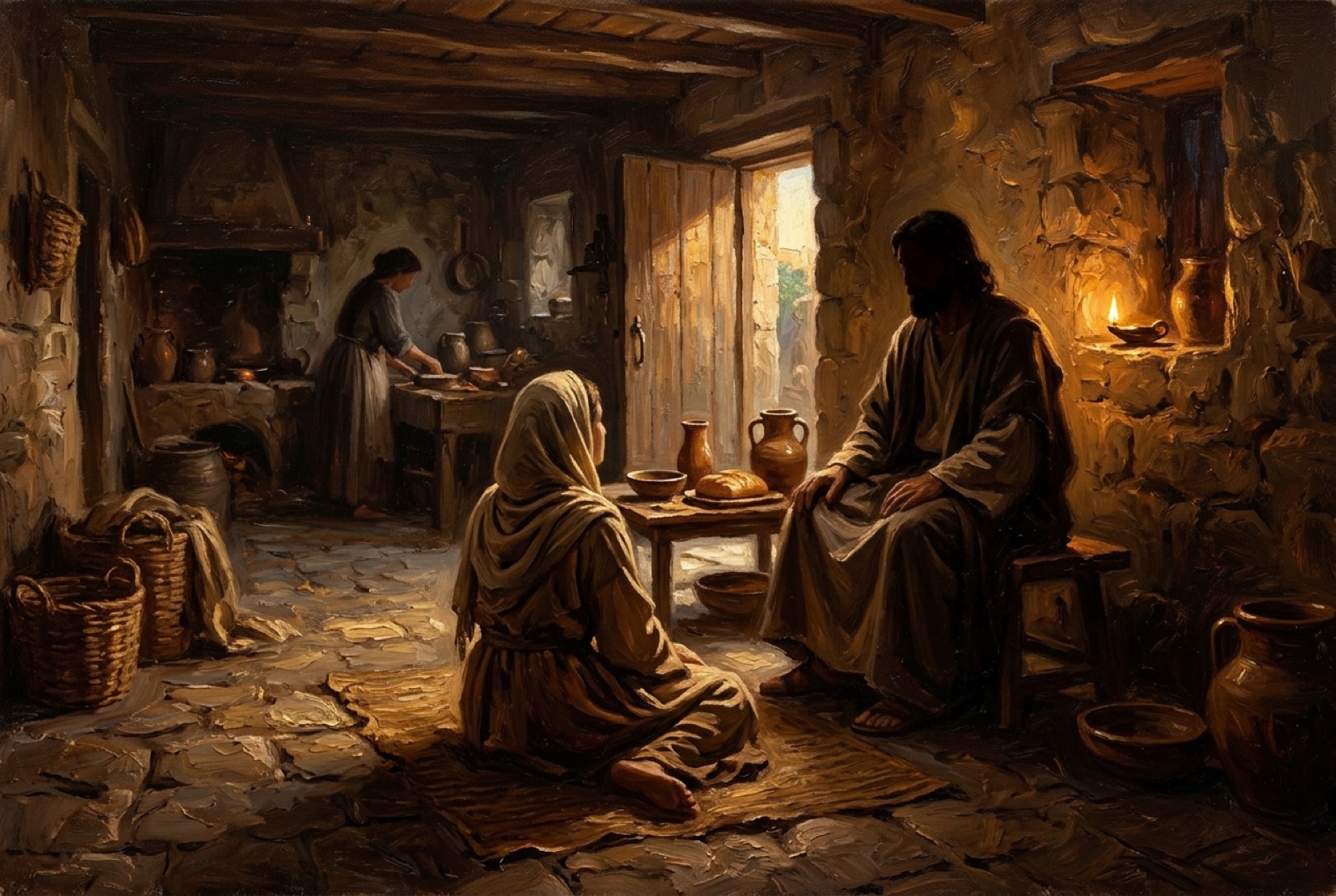
To sit at a teacher's feet was the place of a student. In the book of Acts, Paul says he was brought up "at the feet of Gamaliel," a famous teacher of the law. Mary took that same place in her own house, in front of everyone. Martha was worn out and upset, and she asked Jesus to tell Mary to come and help her. Jesus answered her with kindness, and he did not send Mary away:
But one thing is needful: and Mary hath chosen that good part, which shall not be taken away from her. (Luke 10:42)
No one would take her place as a student away from her, not her sister and not the custom of the town.
Women traveled with him and paid for his work
In the Gospel of Luke, chapter 8, Jesus was going from town to town in Galilee, the hill country north of Jerusalem. His twelve closest followers went with him, and the same passage says women went with him too, and it names them. One was Mary Magdalene, from the town of Magdala on the Sea of Galilee, a woman Jesus had healed. Another was Joanna, the wife of Chuza, who managed the household of Herod Antipas, the ruler of Galilee. Another was Susanna. And the passage says there were "many others."
These women paid for the work out of their own money. They chose to follow Jesus, and they used what they had to keep his teaching going, with no husband deciding for them. This passage comes just after a woman washed his feet with her tears in a Pharisee's house, and just before Jesus told the story of the farmer sowing seed.
He would not let a man throw his wife away
Under the law of Moses, a husband could send his wife away by writing her a short note of divorce. A wife who was sent away could lose her home, her food and her place in the town in one afternoon.
In the Gospel of Mark, chapter 10, Jesus was teaching in Judea, on the far side of the Jordan River. Some Pharisees came to test him. The Pharisees were religious teachers who were very careful about keeping the law. They asked him if a man was allowed to send his wife away. Jesus asked them what Moses had told them, and they said Moses let a man write a note and send her off. Jesus answered that Moses wrote that rule "for the hardness of your heart." It was a rule made for hard hearts, and Jesus never said it came from God.
Later, at the house, his followers asked him about it again, and he said this:
And he saith unto them, Whosoever shall put away his wife, and marry another, committeth adultery against her. And if a woman shall put away her husband, and be married to another, she committeth adultery. (Mark 10:11-12)
Under the old law, the wrong was always done to a man. Jesus said a man who threw his wife away did wrong to her, and so he named the wife as the one who was hurt. He spoke of the husband and the wife in the same way, with the same rule for both. Right after this, in the same chapter, people brought little children to Jesus, and when his followers tried to send them away, he was angry and took the children in his arms.
He made a Samaritan woman his first witness
In the Gospel of John, chapter 4, Jesus was walking north from Judea to Galilee, and he passed through Samaria, the land between them. The people of Samaria and the people of Judea had been rivals for hundreds of years. Tired from the road, Jesus sat down by Jacob's well, near a town called Sychar, at about noon.
A Samaritan woman came to draw water, and Jesus asked her for a drink. She was surprised, because a man from Judea did not ask a Samaritan for anything, and a teacher did not talk alone with a woman. They talked a long time. He knew her whole life, that she had had five husbands and was living with a man who was not her husband, and he did not say one word of blame. When she spoke about the one God was sending, Jesus told her plainly who he was:
Jesus saith unto her, I that speak unto thee am he. (John 4:26)
In the Gospel of John, she is the first person he says it to so plainly. When his followers came back, they "marvelled that he talked with the woman." She left her water jar, ran into the town and told everyone about him, and the Gospel of John says that many people in that town believed in Jesus because of what the woman told them.
Women were the first to find the tomb empty
When Jesus was arrested, most of the men who followed him ran away. The women stayed and watched him die. In the Gospel of Mark, chapter 16, early on the first day of the week, Mary Magdalene, another Mary who was the mother of James, and a woman named Salome went to his tomb with spices for his body. They found the stone rolled away and the tomb empty.
In the Gospel of Luke, chapter 24, the women ran to tell the men, and the men did not believe them:
And their words seemed to them as idle tales, and they believed them not. (Luke 24:11)
In the Gospel of John, chapter 20, Mary Magdalene stood crying outside the tomb, and the risen Jesus spoke her name. She was the first person he sent to tell the others he was alive. In a world where the old law did not let a woman's promise stand without a man's approval, Jesus chose a woman to carry the most important news of all.
No one owns anyone
In the last week of his life, in the temple in Jerusalem, Jesus faced the Sadducees, a group tied to the powerful priestly families, who did not believe the dead would rise. This story is in the Gospel of Matthew, chapter 22, just after Jesus was asked about paying taxes to Caesar, and just before he named the greatest commandment.
The Sadducees told him a story to trap him. A woman married a man, and he died with no children. By the old law, his brother had to marry her. That brother died too, and the next brother married her, until all seven brothers had married her and died. Then they asked Jesus whose wife she would be when the dead rise.
In their story, the woman was handed from one brother to the next like something that belonged to the family. Jesus did not answer the question of whose she would be. He told them she would belong to no one:
For in the resurrection they neither marry, nor are given in marriage, but are as the angels of God in heaven. (Matthew 22:30)
When we are united with the Father, there are no husbands and no wives. No one is the head over anyone else, and no one is counted among a man's things. The order that the old law wrote down, and that the later letter repeated, does not exist with God.
What Jesus gave women
The old law put a wife on a list with a house and an ox. It let a man cancel his wife's promise to God. It handed a young woman to the man who took her, for fifty pieces of silver paid to her father. A letter written later in Paul's name took that same order, the man on top and the woman under him, and set the name of Jesus on it.
Jesus did the opposite with his own hands and his own words. He let Mary keep her place at his feet. He let Joanna, Susanna and Mary Magdalene follow him and pay for his work. He told men that throwing away a wife was a wrong done to her. He told a Samaritan woman who he was, plainly, before anyone else in that gospel heard it. He sent Mary Magdalene to tell the men he was alive. And when the powerful men in the temple made a woman into a puzzle about who owned her, he said that with God, no one owns anyone.
If you are a woman who was told that God made you to come second, or a man who was taught to rule over the people you love, that teaching came from the old law and from the households of the ancient world. In every story where Jesus met a woman, he spoke to her as someone the Father loves fully. The Father who sent him loves his daughters exactly as much as his sons, and there is a place for every one of them at his feet.