A crowd sat on a hillside in Galilee, the hill country north of Jerusalem. There were farmers with dirt still on their hands, fishermen from the lake below, mothers holding small children. Most of them had grown up owing. They owed rent to a landlord and taxes to Rome, and every year they owed the temple in Jerusalem its offerings, the animals and the grain and the coins that were supposed to keep them right with God. Then a teacher from Nazareth stood up in front of them and said that he had come to fulfill the law, to fill it to the top.
The Gospel of Matthew writes that promise with one Greek word, and the word can also mean to pay in full. Jesus did not come to tear the old law down, and he did not come to keep it running forever. He came to carry it all the way to the end, so that no one would ever have to carry it again.
Where he said it
The words are in the Gospel of Matthew, chapter 5. They come near the start of the Sermon on the Mount, the long talk Jesus gave on that hillside, which fills chapters 5, 6 and 7. Just before this, he told the crowd that they were the salt of the earth and the light of the world. Just after it, he began a long list of the old rules, one at a time, and next to each one he said something new.
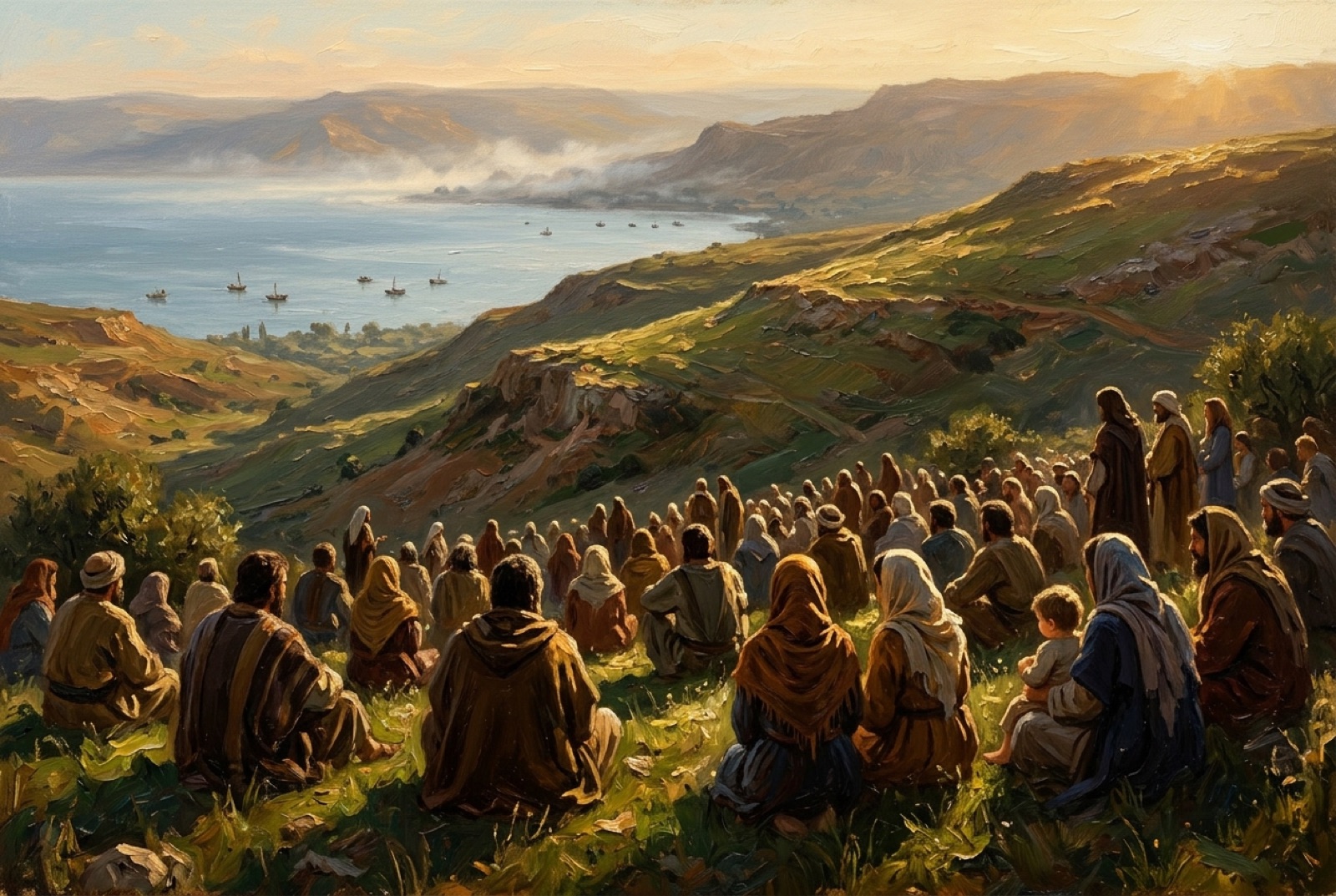
Before he started that list, he knew what some of them would think. They would hear him change the rules and say that he was against the law of Moses, the old law the descendants of Jacob had lived under for hundreds of years. So he spoke to that first:
Think not that I am come to destroy the law, or the prophets: I am not come to destroy, but to fulfil. (Matthew 5:17)
Two Greek words
The Gospel of Matthew was written in Greek, the everyday language of trade all around the sea in those days. The verse turns on two Greek words.
The first is καταλῦσαι (katalysai), the word the King James Bible turns into "destroy." It means to tear down, the way you pull down a wall stone by stone. The Gospel of Matthew uses the same word later, when Jesus looks at the great temple in Jerusalem and says that not one stone will be left on another that is not thrown down. So Jesus says he did not come to knock the law down like a building.
The second word is πληρῶσαι (plērōsai), the word the King James Bible turns into "fulfill." It means to fill up, to make full, to bring something all the way to its end. In the everyday Greek of that time, it was also a word for paying a debt in full. People in Egypt wrote it on their receipts and letters, on sheets of papyrus, a paper made from river reeds, and some of those sheets have survived in the dry sand. One of them was written before Jesus was born, and it uses this word for paying what was owed, all of it.
So the word the Gospel of Matthew chose for what Jesus said is a word that could mean finishing a job, filling a jar to the top, or paying off what you owe until nothing is left. And the rest of the Gospel of Matthew shows him doing exactly that with the law. He carried it through to the end God meant for it, so it would never have to be carried again.
What he did next
Right after he said it, Jesus began his list. He took one old rule after another, and he carried each one past the place where it had stopped.
The first was the rule against killing. The old law said not to kill. Jesus said that anger against your brother, and calling him a fool, already does the harm. He went straight past the act to the heart.
Later in the list he came to one of the oldest rules of all, the rule of getting even.
Ye have heard that it hath been said, An eye for an eye, and a tooth for a tooth: But I say unto you, That ye resist not evil: but whosoever shall smite thee on thy right cheek, turn to him the other also. (Matthew 5:38-39)
The old rule set a limit on revenge, one eye for one eye and no more. Jesus did not make that limit stricter. He ended the getting even. A rule about how much you may hurt someone back has nothing left to do once nobody hurts anyone back.
That is what paying in full looks like. A paid debt is not destroyed. The note is still there, with its amount written on it, but it has nothing more to ask of you. The old law stayed on the page, and Jesus walked it all the way to its end, until the eye for an eye had nothing left to collect.
The letters that said it outright
Jesus said this on a hillside, and the people who followed him spent the next years explaining it to others.
Paul, the traveling teacher who started small groups of believers in towns all around the sea, wrote a letter to the believers in Colossae, a town in the hills of what is now western Turkey. Many of them had spent their lives paying: animals on altars, offerings to priests, holy days that came back every year. Paul told them what happened to all of it:
Blotting out the handwriting of ordinances that was against us, which was contrary to us, and took it out of the way, nailing it to his cross; (Colossians 2:14)
The word behind "handwriting" is χειρόγραφον (cheirographon), "hand-written." In the business world of that time it meant a note of debt, an IOU written in the borrower's own hand. Paul says God wiped that note clean and nailed it up where everyone could see it was finished.
In another letter, to the believers in Rome, Paul said it in a single line:
For Christ is the end of the law for righteousness to every one that believeth. (Romans 10:4)
The Greek word for "end" there is τέλος (telos), which means the end of a road, the finish, the goal reached. And the letter to the Hebrews, written to believers who had grown up with the temple, says the first agreement with God had grown old and was ready to vanish away.
Every one of these says what Jesus said on the hill. The law was not torn down. It was paid in full and brought to its end.
Coming back to the hill
The people on that hillside owed the landlord, they owed Rome, and they owed the temple every year of their lives, and they had been told that God was the one keeping the books. Then Jesus stood up in front of them, and the Gospel of Matthew tells what he said with a word from receipts and rent and the market. He had not come to knock the law down. He had come to fill it to the top, to finish it, to pay it in full.
And then he showed them what that meant. He took the rule against killing to the anger behind it. He took the eye for an eye and ended the getting even. Later, in the Gospel of Matthew, chapter 9, he told the religious teachers to go and learn what it means that God wants mercy and not sacrifice. He was settling an old account so that no one would ever be handed the bill again.
If you were raised to feel that you owe God something you can never pay, that every wrong you do goes into a book against your name, you can let that go. Jesus came to fill the law to the top and pay it in full. When something is paid in full, there is nothing left on the note. What is left is the way he walked, the forgiving and the giving and the loving of enemies, and that is not a debt. It is a life, and it is yours to live freely.