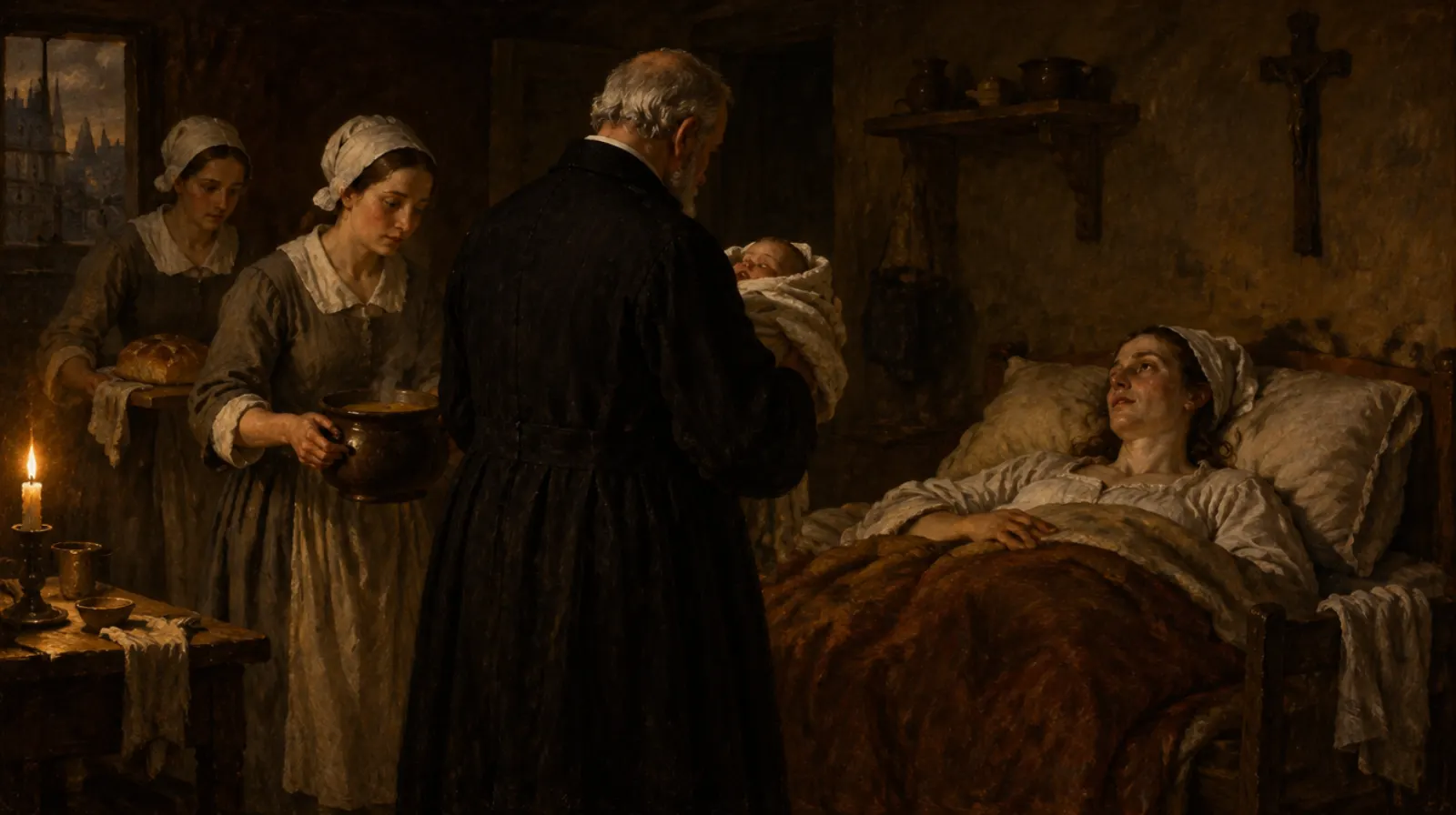
In the 1600s, France was a country of great palaces and terrible poverty. Wars and hunger left families with nothing. Sick people lay alone in their homes with no one to feed them. Babies were left on church steps and in the streets of Paris, and many of them died.
A priest who had once wanted an easy, comfortable life found his way to them.
A sick family
Vincent de Paul was born in 1581 to a poor farming family in the south of France. He became a priest partly because it seemed like a way to a better life. For a while, he worked for rich and powerful families.
Over time, he changed. In 1617 he was serving as a priest in a small town called Châtillon. One Sunday, just before he preached, someone told him about a family nearby where everyone was sick and no one could get food.
He told his church about them. That afternoon, so many people walked out with food that the family had more than they could eat. Vincent saw something in that: people wanted to help, but they needed someone to organize it, so that help kept coming after the first day.
So he gathered the women of the town into a group that took turns bringing meals and care to the sick poor, every day.
The Daughters of Charity
The idea spread. In Paris, he worked with Louise de Marillac, a widow who shared his care for the poor. In 1633 they began training young women from ordinary families to visit the sick in their homes, bring food, and nurse them. They were called the Daughters of Charity.
At that time, most women who served the church lived inside walls, away from the world. Vincent wanted these women out in the streets, in the homes of the poor. He said their convent would be the houses of the sick.
The abandoned babies
In Paris, Vincent learned how many babies were being left in the streets. Many were sold or simply died. He and the Daughters of Charity began taking them in, finding them nurses and homes. Over the years, they cared for thousands of children.
Vincent died in 1660. In 1833, almost two hundred years later, a young student in Paris named Frédéric Ozanam started a group of friends to visit and feed the poor, and named it after Vincent. The Society of St Vincent de Paul now has hundreds of thousands of members around the world. Many of them run food pantries.
Why he did it
Jesus said that whatever we do for the least important people, we do for him.
And the King shall answer and say unto them, Verily I say unto you, Inasmuch as ye have done it unto one of the least of these my brethren, ye have done it unto me.
Matthew 25:40 · King James VersionThe original Greek
καὶ ἀποκριθεὶς ὁ βασιλεὺς ἐρεῖ αὐτοῖς· Ἀμὴν λέγω ὑμῖν, ἐφʼ ὅσον ἐποιήσατε ἑνὶ τούτων τῶν ἀδελφῶν μου τῶν ἐλαχίστων, ἐμοὶ ἐποιήσατε.
Found in Codex Vaticanus (about AD 325), Codex Sinaiticus (about AD 350).
What it means for us
Vincent's great idea was simple. Kindness should not depend on one good afternoon. It should be organized so it keeps coming. Many of us help once and then forget, and that is human.
If you want to help, you could join a meal train, a food pantry shift, or a church group that visits the sick every week. That is the same idea Vincent had in a small French town four hundred years ago.