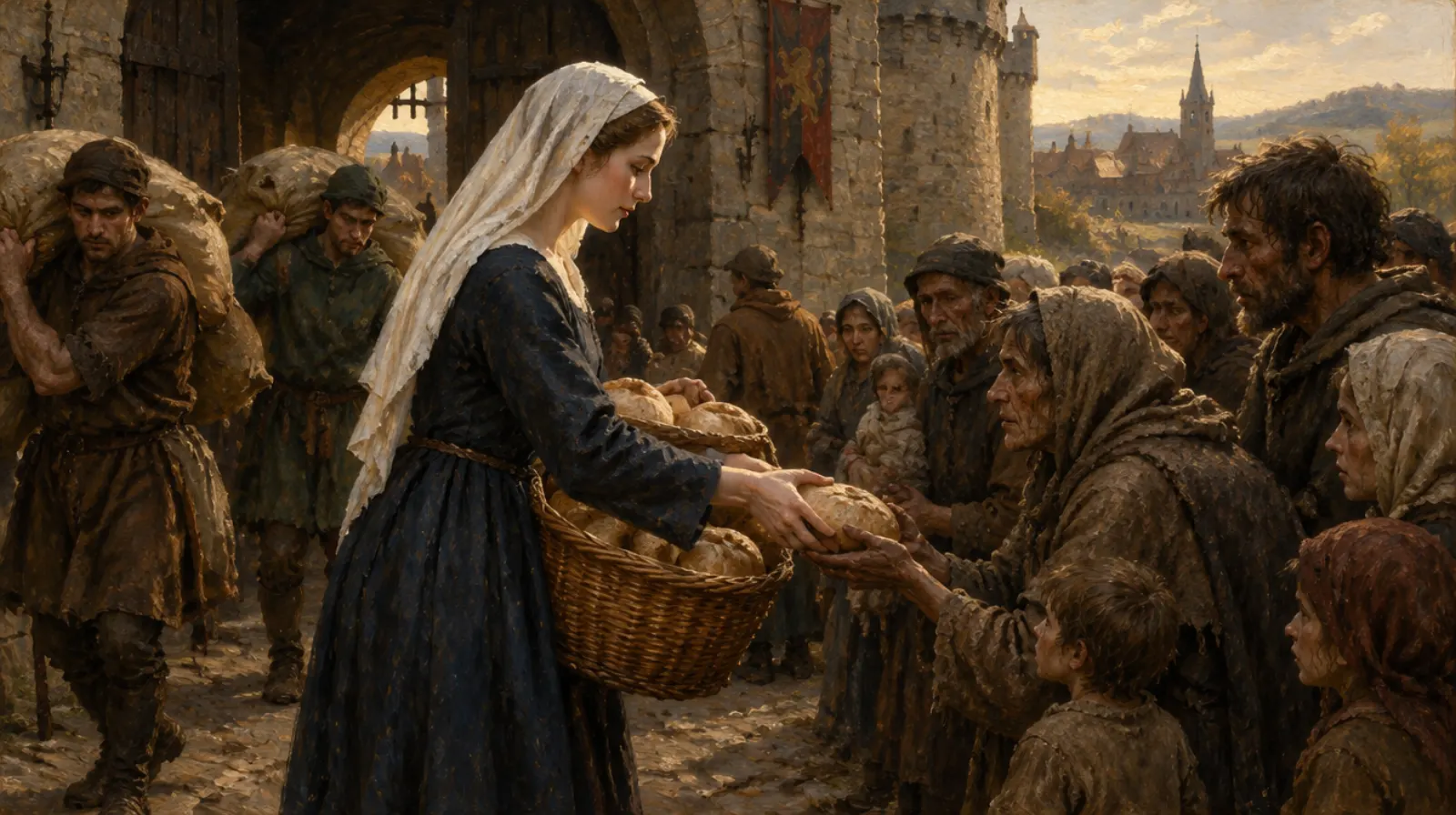
Eight hundred years ago, a princess could have lived in comfort her whole life. She would have fine clothes, good food and servants. Most never thought much about the poor outside the castle walls.
Elisabeth could not stop thinking about them.
A child bride
Elisabeth was born in 1207, the daughter of the king of Hungary, a country in central Europe. As a little girl, she was promised in marriage to a German noble family and sent to live at their castle, the Wartburg, in a region of Germany called Thuringia.
At fourteen she married Ludwig, who became the ruler of Thuringia. By every account, they loved each other deeply. They had three children.
Elisabeth was moved by a new movement of friars who followed Francis of Assisi, an Italian man who gave up everything to live simply and serve the poor. She began to do the same, as much as a princess could.
The famine
In 1226, while Ludwig was away, the crops failed and famine spread across the land. People were starving.
Elisabeth opened the castle's grain stores and gave the food away. She fed hungry people at the gates every day, hundreds of them. She had a small hospital built below the castle for the sick. Some members of the court were furious that she was giving away the family's wealth. She did it anyway.
People later told a story that she was once caught carrying bread hidden in her cloak, and when she opened it, the bread had turned into roses. It is a legend. What is not a legend is that she fed the hungry.
The hospital
In 1227, Ludwig died of illness on his way to a war far away. Elisabeth was twenty, a widow with three small children. She was heartbroken.
She left the castle. In 1228 she built a hospital in the town of Marburg and worked there herself, washing the sick, feeding them and caring for children with no one. She wore plain clothes and lived very simply.
She died in 1231. She was only twenty-four. Four years later, the church named her a saint.
Why she did it
Jesus said that feeding the hungry is feeding him.
For I was an hungred, and ye gave me meat: I was thirsty, and ye gave me drink: I was a stranger, and ye took me in:
Matthew 25:35 · King James VersionThe original Greek
ἐπείνασα γὰρ καὶ ἐδώκατέ μοι φαγεῖν, ἐδίψησα καὶ ἐποτίσατέ με, ξένος ἤμην καὶ συνηγάγετέ με,
Found in Codex Vaticanus (about AD 325), Codex Sinaiticus (about AD 350).
Elisabeth believed him, and she let it cost her a castle.
What it means for us
We do not need to give up everything the way she did. Most of us could not, and Jesus does not ask everyone the same thing. But she shows that wealth is something to share, not a sign of who God loves more. If you have more than you need this week, even a little, you can share it with someone hungry. That is what she did.