For a long time, people with leprosy were sent away from everyone they loved. Leprosy, now called Hansen's disease, is a sickness that damages the skin and nerves. People were terrified of catching it. In Hawaii in the 1800s, people who had it were taken from their families and sent to live on a strip of land on the island of Molokai, cut off by tall cliffs and the sea.
Life there was very hard. There was not enough food, shelter or care.
The priest who went
Damien was a young Catholic priest from Belgium, a country in Europe. He had come to Hawaii as a missionary. In 1873, church leaders asked for priests to take turns visiting the settlement at Kalaupapa, on Molokai. Damien volunteered, and then asked to stay.
He was thirty-three years old.
What he did
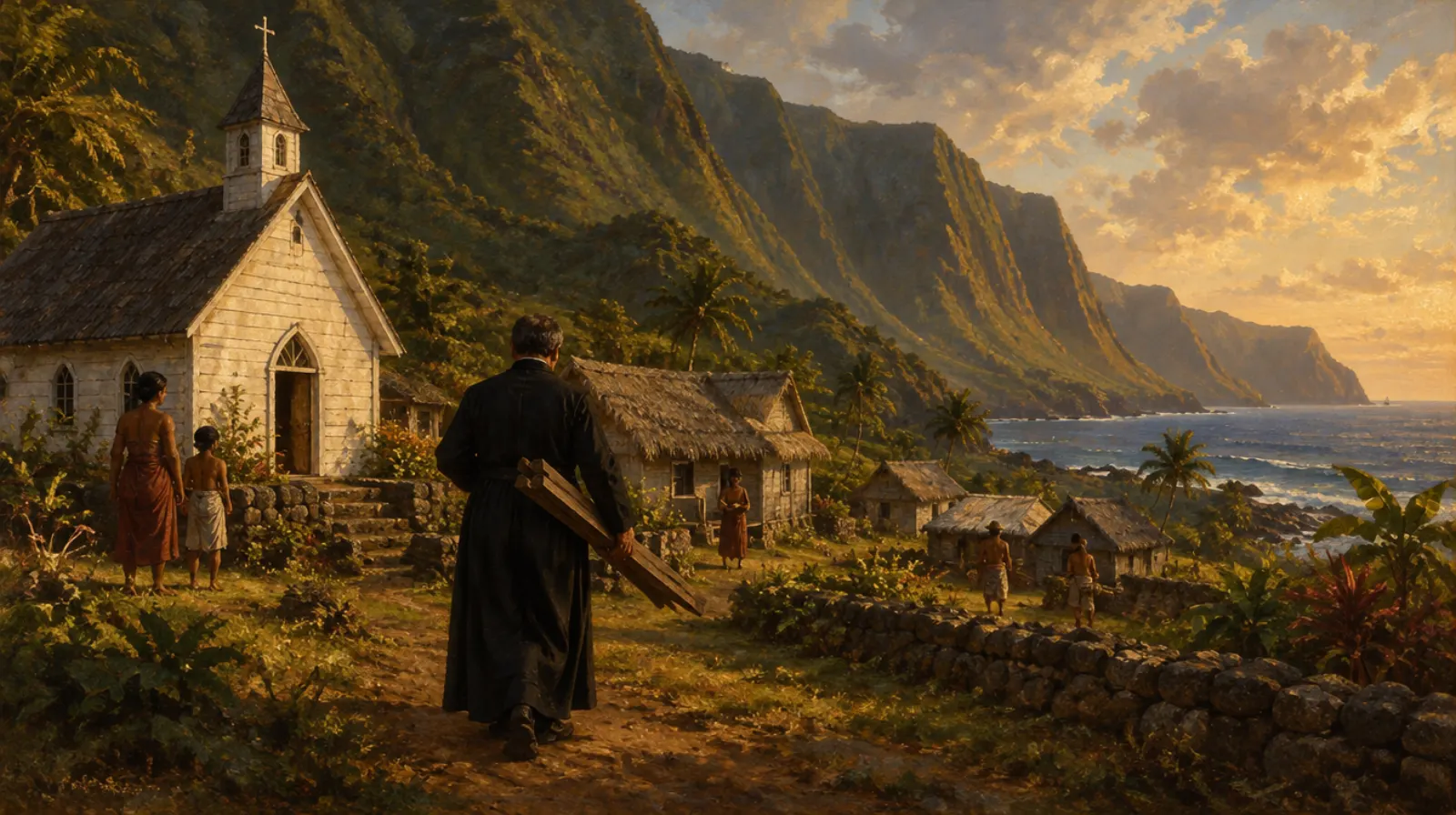
Damien did not only preach. He worked with his hands. He helped build houses and a church. He made coffins and dug graves, because people were dying and someone had to bury them with dignity. He dressed wounds that others would not touch. He started a home for children who had no one.
He also lived the way the people there lived. He ate with them and touched them, when most people would not come near.
He became one of them
In 1884, Damien realized he had leprosy too. He kept working. He died at Kalaupapa in 1889, at forty-nine.
Other people came to help because of him, including Marianne Cope, a nun from New York who arrived in 1888 and cared for the sick there for thirty years.
In 2009, the Catholic Church named Damien a saint. Today a statue of him stands in the United States Capitol, sent by the state of Hawaii.
What it means for us
We Christians have sometimes pushed sick people away, out of fear, just like everyone else. Damien went the other way. He went toward them, and stayed.
Most of us will never move to an island. But we all know someone who feels shut out: sick, ashamed, or alone. If you go toward them, sit with them and take their hand, you are giving the same mercy Damien gave, just closer to home.